Blog
Meditation for Productivity: A Guide to AI-Assisted Focus
Meditation for productivity isn't just relaxation — it's attention training plus environment design. Learn routines and AI-enforced focus workflows that actually hold.
 Mil Hoornaert · 16 min read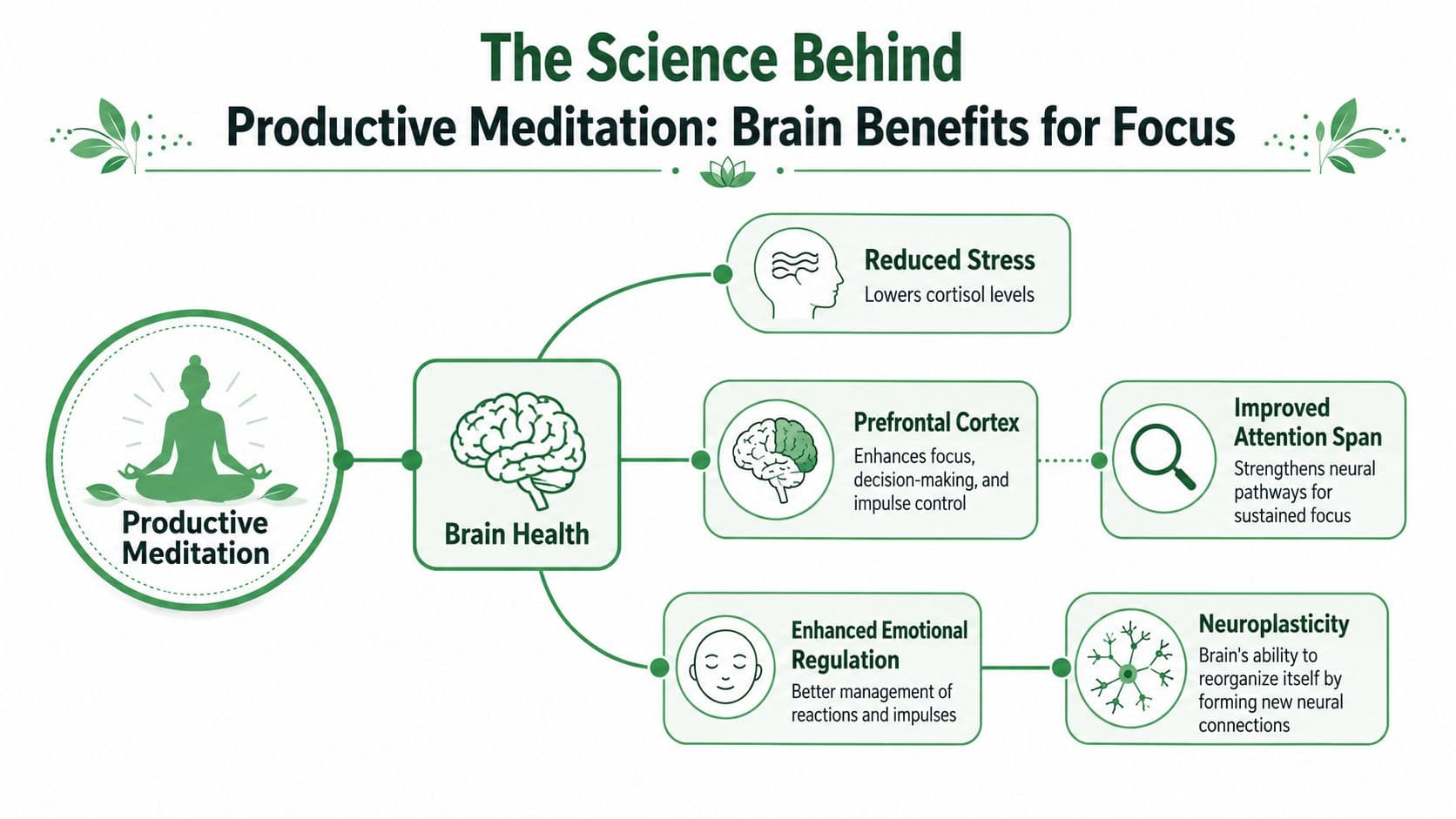
You sit down to do important work. The task is clear. The deadline is close enough to matter. Then the familiar drift starts. You check one message, open one tab, answer one “quick” notification, and suddenly your attention is scattered across six browser windows and half a dozen unfinished thoughts.
That is often treated as a discipline problem. It usually isn't. It's an attention training problem mixed with an environment problem. Meditation can train the first. A stricter digital workflow can handle the second. When you combine both, meditation for productivity stops being a vague wellness habit and starts working like a professional operating system.
The missing piece in most advice is this. Relaxation meditation helps, but knowledge workers also need a version of meditation that supports analysis, decision-making, and problem-solving. That's where productive meditation matters. It gives your mind a structure for thinking well, not just a break from thinking.
Why Willpower Is Not Enough for Modern Deep Work
A distracted workday doesn't usually fail at the level of motivation. It fails at the level of repeated interruption. You may care a great deal about the task in front of you and still lose focus because your attention has been trained to react faster than it can stabilize.
That's why “just try harder” is weak advice. Willpower is useful for starting a session. It's unreliable for protecting an entire morning from email, chat pings, browser drift, and the habit of self-interruption. Deep work needs trained attention, not pep talks.
Meditation helps because it gives attention a repeatable workout. You notice your mind move. You bring it back. You repeat the rep. Over time, that loop gets faster and cleaner. The practical result isn't mystical. You catch distraction earlier and recover from it with less friction.
A study on meditation, work engagement, and job performance found that meditation practice predicted subjective job performance (β = 0.116, p < .001) and work engagement (β = 0.112, p < .001) in a sample of 1,470 participants, even after adjusting for covariates. That matters because it shifts meditation from “nice if you have time” into “relevant if your job depends on sustained cognitive output.”
Attention is trainable
A lot of knowledge workers approach focus backward. They build a to-do list, open their apps, and hope concentration appears on demand. Attention doesn't work that way. It responds to practice.
Three patterns show up constantly:
- Reactive checking: You don't choose to switch tasks. A cue pulls you.
- Cognitive residue: Part of your mind stays attached to the previous task.
- Low-friction escape routes: The easiest click usually wins.
Meditation directly targets the first two. It teaches you to see a mental impulse before you obey it. For the third problem, you still need environmental controls. That's why tools matter alongside practice.
Practical rule: Use willpower to begin, then use systems to continue.
If you need help tightening the external side of focus, this guide to distraction blockers for modern deep work is useful. The key is to stop assuming your brain should win every battle unaided against an environment built to capture attention.
What actually changes at work
Meditation for productivity doesn't make every session peaceful. That's not the point. The point is operational. You become better at:
- Starting faster when resistance shows up.
- Staying with one problem longer before seeking novelty.
- Returning cleanly after interruption or mental drift.
That last skill is underrated. High performers don't avoid every distraction. They recover faster than everyone else. Meditation builds that recovery loop. In modern deep work, that's often more valuable than raw motivation.
The Science Behind Productive Meditation
Many associate “meditation” with stress reduction. That's only part of the story. For productivity, the more useful frame is cognitive training. You're not trying to become blank. You're trying to become more stable, more deliberate, and less hijacked by noise.
That distinction matters because different meditation styles produce different work outcomes. A breathing session before a hard task can lower internal turbulence. A structured thinking walk can help you solve the task itself. If you treat both as the same thing, you'll use the wrong tool at the wrong time.
Passive calm and active cognition
Passive meditation is what most apps teach well. Sit still. Follow the breath. Notice thoughts. Return gently. That style is good for reducing agitation and preparing your mind to work.
Productive meditation is different. Anthony Sanni's explanation of productive meditation as structured problem-solving during a routine activity highlights the gap many mainstream guides miss. Instead of “do nothing,” you choose a specific problem, define the variables, and keep returning to that problem when your mind starts looping or drifting.
That changes the role of meditation completely. It becomes a scaffold for cognitive work.
The goal isn't to have fewer thoughts. The goal is to have better-directed thoughts.
Here's the practical contrast:
- Passive meditation: Best before deep work, after conflict, or when your nervous system is noisy.
- Productive meditation: Best when you're stuck on a strategic question, design problem, writing structure, or decision with multiple moving parts.
A routine activity helps. Walking is ideal because the body stays occupied while the mind works. Folding laundry, commuting on foot, or pacing indoors can work too. The activity should be simple enough that it doesn't compete with thinking.
Here's a useful visual summary before the business case side of the topic:
Why companies keep testing mindfulness at work
Companies don't keep investing in meditation programs because it sounds elegant. They do it because attention, absenteeism, injuries, and output affect the business.
A report on corporate meditation programs and employee productivity describes several concrete outcomes, including a U.S. healthcare company that partnered with Duke University and reported a financial productivity gain of $3,000 per employee, plus evidence that a single guided meditation session improved focus and reduced mind-wandering by 22%.
Those figures don't mean every meditation session creates instant excellence. They do show that the practice can have measurable effects in work settings. For individual contributors, that's the relevant threshold. You don't need transcendence. You need cleaner attention, better decisions, and fewer wasted work blocks.
Your Meditation Toolkit for Deep Work Routines
Meditation becomes useful when it has a job. “I should meditate more” is too vague to survive a busy calendar. A better approach is to assign a specific routine to a specific work moment.
The most effective routines are short, predictable, and tied to triggers that already happen in your day. Between meetings. Before a writing block. After a demanding session when your brain won't detach. Once you place meditation inside your workflow, it stops competing with work and starts supporting it.
The routines that fit a real workday
Not every session should aim for stillness. Productive meditation works best when the structure matches the task.
Use these principles:
- Match the routine to the friction: If you're mentally scattered, use a reset. If you're avoiding a hard task, use a pre-work primer. If you're overextended after a long focus block, use a cooldown.
- Give the mind one clear instruction: “Notice the breath” works. “Think about everything calmly” doesn't.
- Separate planning from looping: Productive meditation means working a problem with intention, not replaying the same annoyance.
The distinction matters. As discussed in Anthony Sanni's framework, productive meditation involves choosing a routine activity, structuring deep thinking on a specific problem, defining variables, and avoiding looping thoughts. If you need a modern example of this kind of deliberate study rhythm, this article on studying smarter with AI while staying distraction-free shows the same principle in a different context.
Productivity meditation routines
| Routine | Duration | Best For | Sample Script Focus |
|---|---|---|---|
| Micro-Reset | 1 minute | Switching contexts after meetings or messages | “Exhale fully. Feel both feet. Name the next task. Ignore every task after that one.” |
| Pre-Work Primer | 10 minutes | Starting writing, coding, analysis, or research | “Breathe slowly. Identify the single output that matters. If thoughts wander, return to the first concrete step.” |
| Post-Session Cooldown | 15 minutes | Detaching after deep work and preventing mental spillover | “Release the task. Notice what still feels unresolved. Write it down later, don't carry it in your head.” |
The table matters less than the behavior behind it. Each routine has a narrow purpose. That's why it works.
Micro-Reset
This is the emergency brake for context switching. Use it when a meeting ends, a Slack thread spikes your stress, or your brain feels “sticky” from the previous task.
Try this sequence:
- Sit upright or stand still.
- Exhale longer than you inhale for a few breaths.
- Mentally label the next task in five words or fewer.
- Start immediately before your mind starts negotiating.
This session shouldn't feel profound. It should feel mechanical. That's good. You're clearing residual noise, not searching for insight.
Pre-Work Primer
This is the most practical meditation for productivity if your work depends on concentration. You're preparing the mind to stay on one object for long enough that meaningful output appears.
A good script sounds like this:
“For the next block, I am doing one thing. The output is clear. The first action is clear. When my mind wanders, I return without argument.”
Keep the scope tight. Don't meditate on the entire project. Meditate on the next visible unit of progress. If you're writing, choose the section. If you're coding, choose the function or bug. If you're analyzing, choose the exact question.
Post-Session Cooldown
Many focused people make one predictable mistake. They finish a hard session, then carry the task into the next hour as low-level mental residue. The body may stop working, but the mind doesn't.
Cooldown meditation fixes that. Walk slowly, breathe naturally, and let the mind surface whatever remains unresolved. Don't solve it yet. Just notice it. If something important appears, capture it after the session.
Field note: If meditation makes you more aware of unfinished work, that's not a regression. It means you're noticing cognitive residue early enough to manage it.
This routine is especially useful for people who work with AI tools all day. AI can speed task generation so much that your mind never gets a natural stopping signal. A cooldown restores one.
How to Supercharge Meditation with LockIn MCP
Meditation creates readiness. It doesn't enforce anything. You can finish a great session, feel centered, open your laptop, and lose the state in two minutes because your digital environment still rewards interruption.
That's where an enforcement layer changes the outcome. LockIn MCP connects AI assistants to system-level focus controls. Instead of hoping you'll resist the usual sites and behaviors, you can have your assistant trigger a focused environment that blocks distractions across browsers and apps. The practical details are explained on the LockIn MCP product overview.
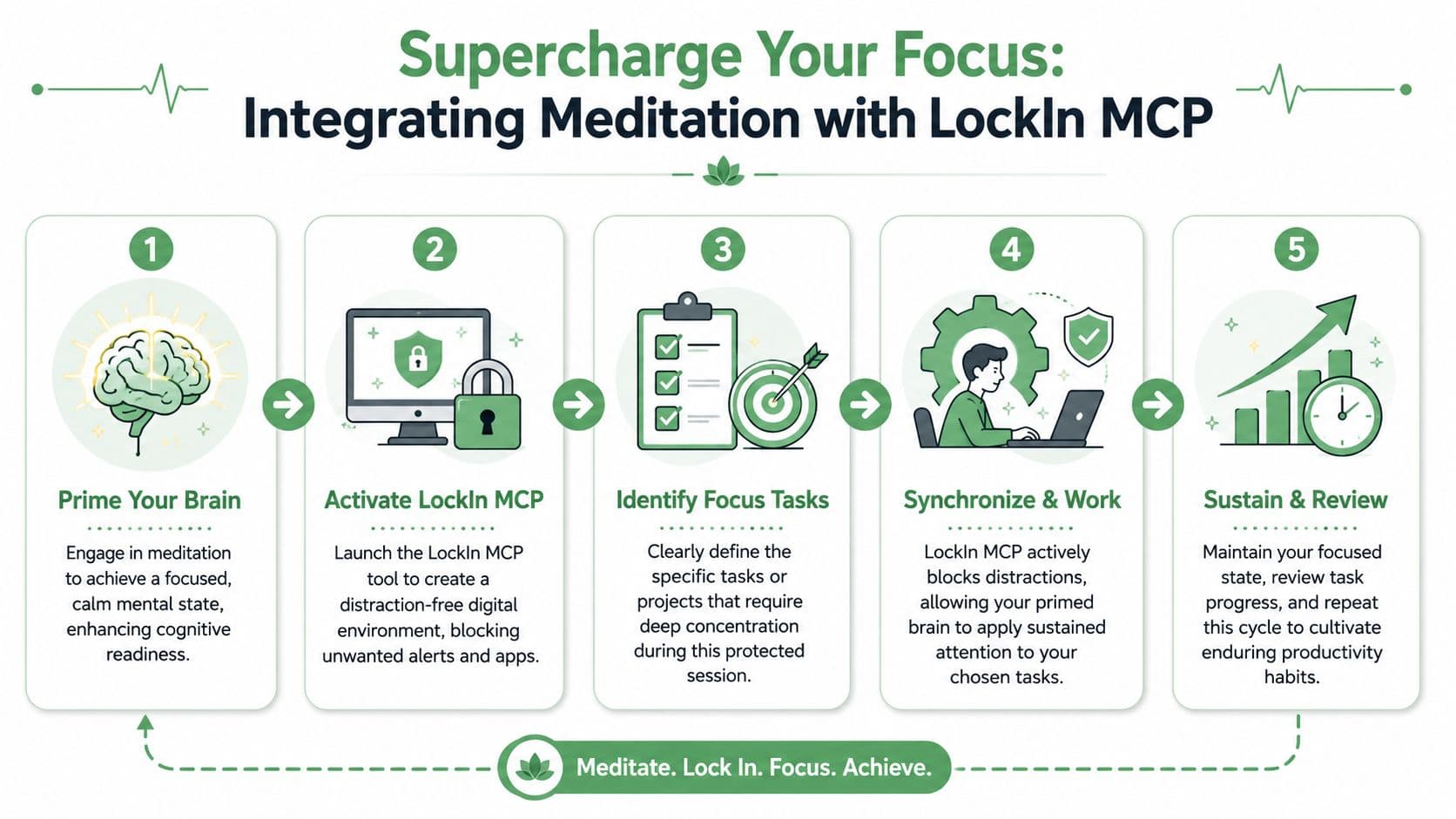
The reason this pairing works is simple. Meditation handles the internal state. An AI-enforced focus session handles the external temptations. Each covers what the other can't.
Turn intention into enforcement
A strong workflow looks like this:
- Prime your attention: Do a brief pre-work meditation.
- State the objective out loud or in text: Name the exact task.
- Have the assistant activate a focus session: Remove high-friction temptation points before you begin.
- Work inside the protected window: Don't renegotiate the rules mid-session.
- Use temporary exceptions sparingly: If you need access, make it time-limited.
This is better than relying on generic blockers alone because the assistant can turn your intention into action with natural language. You don't need to hunt through settings while your focus is fading.
A focus ritual only counts if it survives contact with your actual laptop.
For knowledge workers using ChatGPT, Claude, Gemini, Perplexity, or Poke, this matters because AI is already part of the workflow. The same assistant helping you outline a report or debug code can also help protect the work block where that output gets made.
Copyable AI workflows
Here are practical prompts that pair well with meditation for productivity.
Prompt for starting a focus block
“I just finished a 10-minute meditation. Start a 60-minute focus session. Block entertainment and social sites. My task is drafting the proposal introduction and first two sections. Ask me for the next concrete step if I drift.”
This works because it combines state, duration, boundaries, and output. It also gives the assistant a role beyond blocking. It can help you recover when attention slips.
Prompt for a structured productive meditation
“I'm going on a walk for productive meditation. Help me define one problem clearly. Ask me for the decision, the variables, and the constraints. Then summarize the thinking prompt in three short lines I can carry into the walk.”
That turns the session into guided cognition instead of loose rumination.
Prompt for a temporary exception
“I need brief access to one blocked site for a work task. Give me a short breathing cue first, then enable a timed temporary unblock and remind me of the single item I need before the timer ends.”
This is one of the smartest uses of AI in a focus system. You're not only granting access. You're interrupting impulsive behavior with a small conscious pause.
Prompt for status without losing flow
“Check my current focus status and tell me only what I need to know to stay on task.”
The best status checks are minimal. If the assistant dumps too much information on you, the check becomes another distraction vector.
What works and what doesn't
The combination is powerful, but only if you avoid common mistakes.
What works:
- Short meditation before activation: You enter the block with less cognitive noise.
- Task-specific prompts: The assistant can reinforce a concrete outcome.
- Timed exceptions: Access expires automatically, which protects against drift.
- Simple rules: Fewer categories, fewer loopholes.
What doesn't work:
- Starting blocks with vague goals: “Work on project” is too fuzzy.
- Using meditation as procrastination: If you keep extending the ritual, you're avoiding the task.
- Leaving unblock decisions unbounded: Open-ended access breaks the whole system.
- Overcomplicated prompt stacks: If your setup needs a manual, you won't use it consistently.
The larger point is that focus improves when your internal and external systems agree. Meditation tells your mind what matters. AI enforcement keeps your devices from arguing back.
Common Meditation Pitfalls and How to Overcome Them
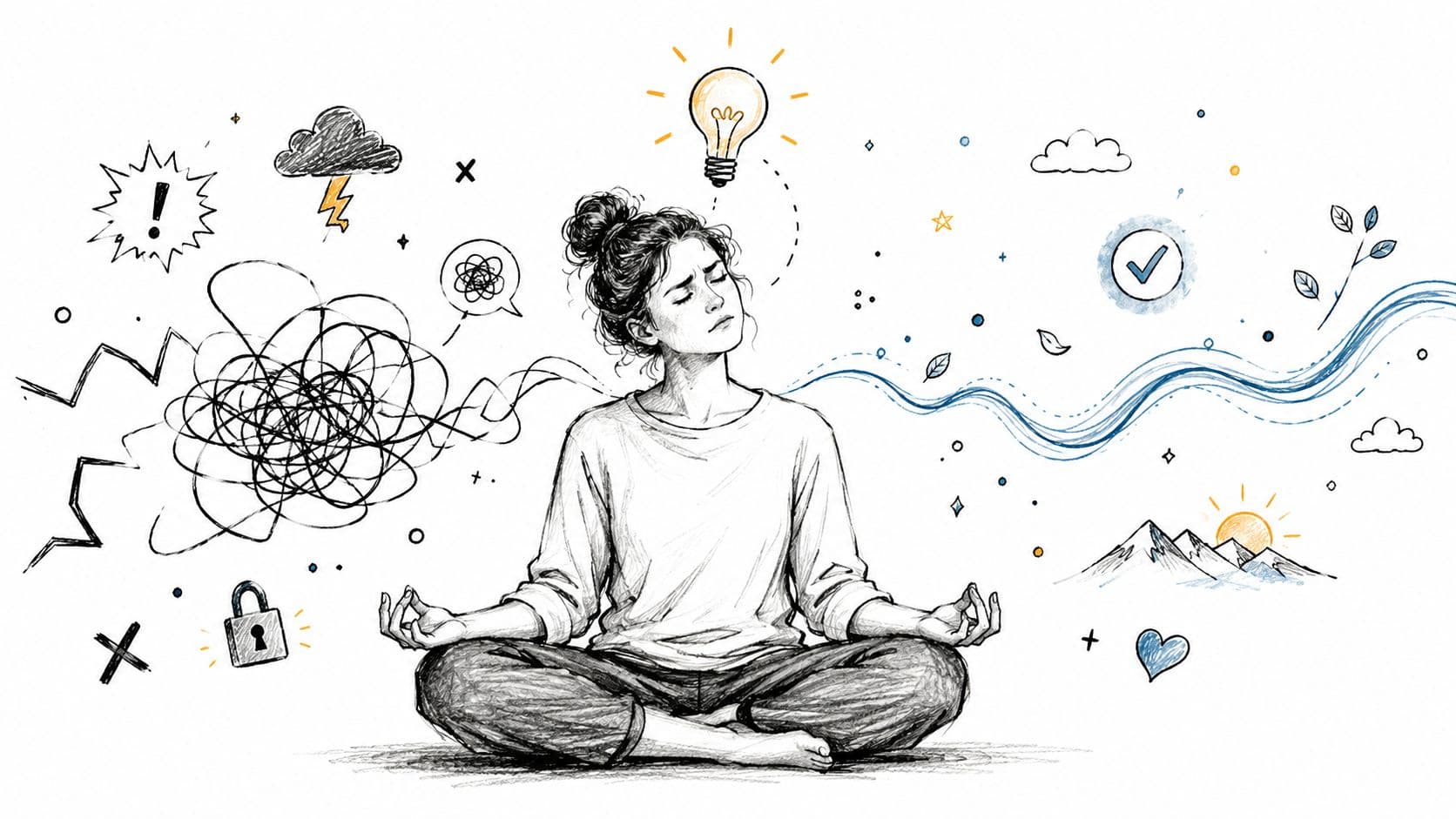
People don't stop meditating because the idea is bad. They stop because they misread normal friction as evidence that they're failing. That misunderstanding is expensive, especially for people trying to build meditation for productivity rather than for pure relaxation.
What people mistake for failure
The first trap is “I can't clear my mind.” You're not supposed to. A working meditation session includes distraction. The practice is in noticing and returning.
The second trap is “I don't have time.” In reality, the hidden time cost of repeated mental fragmentation often goes unaddressed. A short reset before a demanding task often saves more time than it consumes because the work starts cleaner.
Two more errors show up after that:
- “It doesn't feel like it's working.” Productivity meditation often feels ordinary while it's helping. The signal is better task re-entry, less tab drift, and more coherent thinking.
- “I got distracted again.” Of course you did. That repetition is the training stimulus.
Missing the point of meditation is easy if you judge the session by how serene it felt instead of how well you worked afterward.
How to recover without quitting
A better response is to adjust the practice, not abandon it.
If your mind races, shorten the session and tighten the instruction. Don't say “relax.” Say “follow ten breaths” or “return to the problem statement.” Specificity helps.
If you keep skipping sessions, attach them to existing triggers:
- After meetings: Do the 1-minute reset.
- Before hard tasks: Use the 10-minute primer.
- After intense work: Walk the cooldown.
If productive meditation turns into worry, the structure is too loose. Name the decision you're working on. List the variables mentally. When the mind starts replaying the same emotional loop, return to the variables.
That's the recurring pattern with meditation. Small corrections beat dramatic reinventions. The people who benefit most aren't the ones who never drift. They're the ones who expect drift, recover quickly, and keep the practice useful.
Building Your Sustainable AI-Powered Focus System
The durable version of productivity doesn't come from one more trick. It comes from combining internal regulation with external protection. Meditation trains your attention. AI-enforced focus sessions protect that attention when work begins.
That combination is more realistic than either approach alone. Meditation without boundaries leaves you exposed to digital pull. Blocking without mental preparation can feel brittle and resentful. Put them together and the system holds.
Start small. Tomorrow, do one 5-minute pre-work meditation, then one 60-minute focus block with your AI assistant enforcing the environment. Pick a task with a visible output, not an abstract ambition. A paragraph drafted. A bug fixed. A brief analyzed.
Keep the loop simple:
- Calm the mind.
- Name the task.
- Protect the environment.
- Review what worked.
That's how meditation for productivity becomes sustainable. Not as a wellness accessory, but as part of a repeatable operating rhythm for serious work.
If you want a practical way to connect your AI assistant to system-level focus controls, LockIn MCP gives you a direct way to turn a calm, intentional work state into an enforced deep work session across your device.